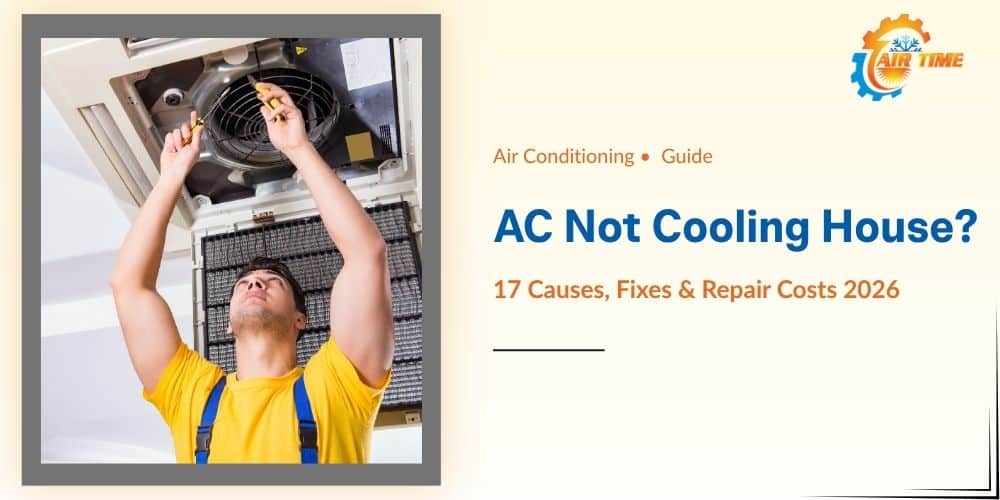
You lower the thermostat expecting relief from the summer heat, but your house still feels warm and uncomfortable. The AC seems to be running normally, air is coming from the vents, and yet the temperature indoors barely changes. Meanwhile, your energy bill continues climbing while your family struggles to stay comfortable.
If your AC is not cooling the house, there is usually an underlying issue preventing the system from removing heat effectively. Sometimes the solution is as simple as replacing a dirty air filter. Other times, the problem may involve refrigerant leaks, compressor issues, or failing electrical components. Understanding the cause can help you determine whether it’s a quick DIY fix or a problem that requires professional attention.
Why Is My AC Not Cooling House?
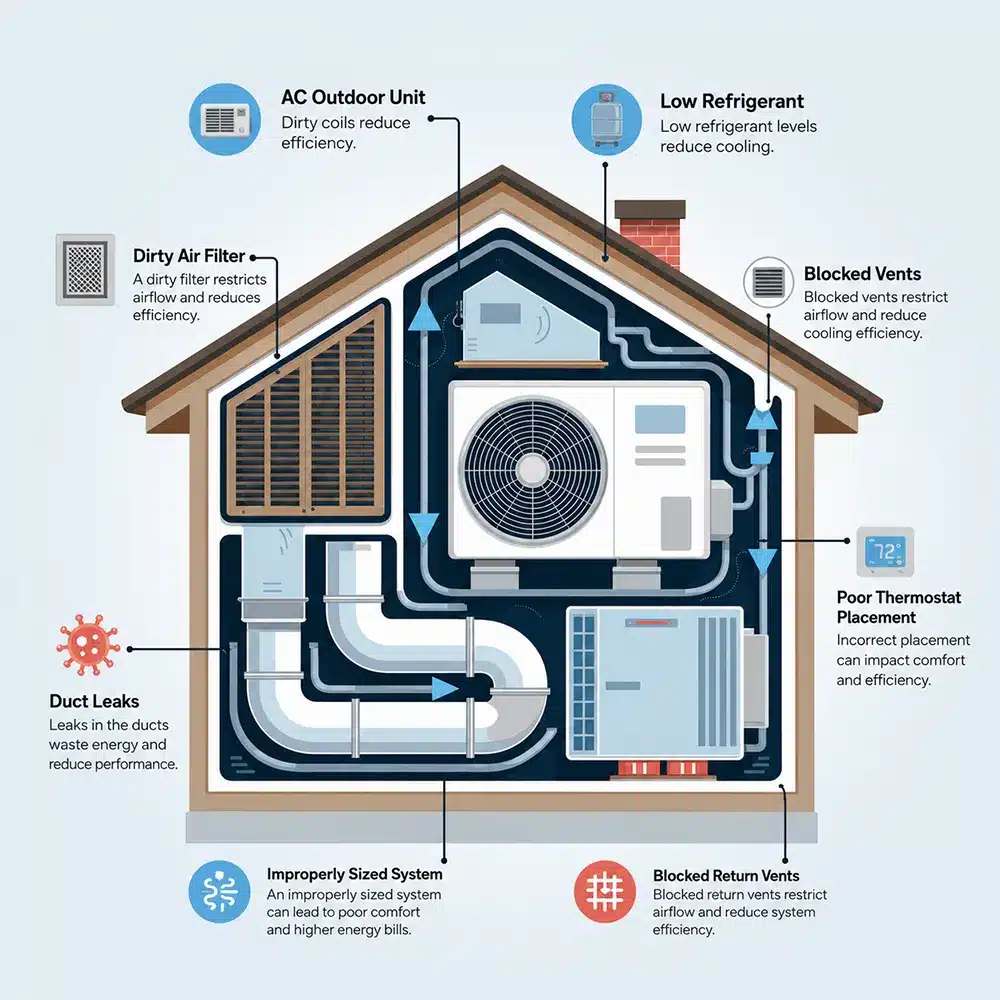
An air conditioner cools your home by removing heat from indoor air and transferring it outside. For this process to work properly, the system needs adequate airflow, correct refrigerant levels, functioning electrical components, and a healthy compressor.
When any of these elements fail, your AC may continue running without effectively lowering indoor temperatures.
The good news is that many cooling issues show warning signs before they become major repairs.
17 Reasons Your AC Is Not Cooling Your House
Before diving into specific problems, it helps to understand how your AC works.
Your indoor unit pulls warm air from your home through return vents. The evaporator coil absorbs heat from that air using refrigerant. The refrigerant then travels to the outdoor unit, where the condenser releases the heat outside. Finally, cooled air is sent back through your ductwork and into your living spaces.
If airflow becomes restricted, refrigerant levels drop, or a major component fails, the cooling process becomes less effective. As a result, your home stays warm even while the system appears to be operating. Here are the common reasons the AC runs but doesn’t cool.
1. Dirty Air Filter
A clogged air filter is one of the most common reasons an AC is not cooling properly. As dirt, dust, and pet hair accumulate on the filter, airflow throughout the system becomes restricted.
When airflow decreases, your air conditioner must work harder to cool your home. In severe cases, restricted airflow can even cause the evaporator coil to freeze.
Homeowners often notice:
- Weak airflow from vents
- Rooms cooling unevenly
- Higher utility bills
- Longer cooling cycles
Replacing the filter is one of the easiest and most affordable troubleshooting steps.
2. Incorrect Thermostat Settings
Sometimes the issue has nothing to do with the air conditioner itself.
A thermostat accidentally set to “Fan” instead of “Cool” can circulate air without actually cooling it. Dead batteries, programming errors, or incorrect temperature settings can also prevent proper operation.
Before assuming a major repair is needed, verify that:
- The thermostat is set to cooling mode
- The desired temperature is lower than room temperature
- Batteries are functioning properly
- Schedules are configured correctly
3. Blocked or Closed Air Vents
Your AC depends on unrestricted airflow throughout the home. Closed supply vents or blocked return vents can reduce efficiency and create uneven temperatures.
Furniture, curtains, rugs, and other household items frequently obstruct airflow without homeowners realizing it.
Walk through your home and confirm that all vents are open and free from obstructions.
4. Dirty Evaporator Coil
The evaporator coil absorbs heat from indoor air. Over time, dirt can accumulate on the coil’s surface, reducing its ability to transfer heat effectively.
When this happens, your AC may continue running but struggle to cool the house.
Common symptoms include reduced cooling performance, weak airflow, and rising indoor humidity levels.
Professional coil cleaning often restores system efficiency and improves cooling performance.
5. Frozen Evaporator Coil
If airflow becomes restricted or refrigerant levels fall too low, the evaporator coil may freeze.
Many homeowners are surprised to learn that ice formation can actually prevent an air conditioner from cooling. Instead of absorbing heat, the frozen coil blocks proper heat transfer.
Signs of a frozen coil include:
- Ice on refrigerant lines
- Water around the indoor unit
- Reduced airflow
- Warm air from vents
Turning the system off can allow the ice to melt, but the root cause still needs to be addressed.
6. Dirty Condenser Coils
Your outdoor unit is responsible for releasing heat removed from your home. When condenser coils become coated with dirt and debris, heat cannot escape efficiently.
As outdoor temperatures rise, dirty coils force the system to work significantly harder.
Regular maintenance helps prevent this issue. Homeowners can gently rinse debris from the outdoor unit after disconnecting power, though heavily soiled coils may require professional cleaning.
7. Debris Around the Outdoor Unit
Many cooling problems begin outside.
Shrubs, leaves, weeds, and fencing placed too close to the condenser can restrict airflow and reduce performance. The outdoor unit needs space to breathe to release heat efficiently.
Experts typically recommend maintaining at least two feet of clearance around the condenser.
8. Low Refrigerant Levels
Refrigerant plays a critical role in transferring heat out of your home. When levels become low, cooling capacity drops significantly.
Unlike gasoline in a car, refrigerant does not get “used up.” If levels are low, there is usually a leak somewhere in the system.
Low refrigerant often causes:
- Warm air from vents
- Frozen coils
- Long cooling cycles
- Increased energy consumption
Professional diagnosis is necessary to identify and repair the leak.
9. Refrigerant Leak
A refrigerant leak can make it nearly impossible for your AC to cool effectively.
Leaks may develop because of corrosion, vibration, or damaged connections. Simply adding refrigerant without fixing the leak provides only temporary relief.
A qualified HVAC technician should:
- Locate the leak
- Repair the damaged area
- Recharge refrigerant levels
- Verify system performance
10. Tripped Circuit Breaker
Electrical issues can prevent parts of your air conditioning system from operating properly.
For example, the indoor unit may continue running while the outdoor condenser loses power. This situation often causes homeowners to wonder why their AC is blowing air but not cooling.
Check your electrical panel for any tripped breakers before scheduling service.
11. Failed Capacitor
Capacitors provide the electrical boost necessary to start and run AC motors.
When a capacitor begins failing, the outdoor unit may struggle to start or stop working altogether.
Homeowners commonly report:
- Clicking sounds
- Humming noises
- Intermittent operation
- Warm air indoors
Capacitor replacement is a common HVAC repair.
12. Faulty Contactor Relay
The contactor acts like an electrical switch that sends power to the outdoor unit.
When the contactor fails, the compressor may not receive power even though the thermostat is calling for cooling.
This issue often requires professional testing and replacement.
13. Outdoor Fan Motor Failure
The condenser fan helps remove heat from the outdoor coil.
If the fan motor stops working, heat remains trapped inside the system. As temperatures rise, cooling performance declines rapidly.
A failing fan motor may produce unusual noises before complete failure occurs.
14. Compressor Problems
The compressor is often called the heart of the air conditioning system.
Its job is to circulate refrigerant between indoor and outdoor components. If the compressor becomes damaged, the cooling cycle cannot function correctly.
Common warning signs include:
- Warm air from vents
- Loud operating noises
- Frequent breaker trips
- Reduced cooling capacity
Compressor repairs can be among the most expensive AC repairs.
15. Locked Rotor or Seized Compressor
In older systems, internal compressor components can become stuck.
This condition prevents the compressor from starting normally. Some units may attempt repeated startups before shutting down completely.
You may hear loud buzzing noises or notice the system struggling to operate.
A professional evaluation can determine whether repair or replacement is the better option.
16. Poor Home Insulation
Sometimes the AC is functioning properly, but the home itself is losing cooled air too quickly.
Poor insulation allows outdoor heat to enter while conditioned air escapes. This forces the AC to run longer and harder throughout the day.
Common problem areas include:
- Attics
- Windows
- Exterior walls
- Crawl spaces
Improving insulation can dramatically improve comfort and reduce cooling costs.
17. Aging Air Conditioning System
Even well-maintained systems eventually lose efficiency.
Most residential air conditioners last between 10 and 15 years. As equipment ages, components wear out and cooling performance gradually declines.
If your AC requires frequent repairs and struggles to maintain comfortable temperatures, replacement may be more cost-effective than continued repairs.
Is It Normal for an AC to Run All Day in Texas?
Many Texas homeowners become concerned when their AC seems to run continuously during the summer. In most cases, longer cooling cycles are normal when outdoor temperatures exceed 95°F or even 100°F.
Air conditioners are designed to maintain indoor comfort, not instantly cool a home. During extreme Texas heat, your system may need to run for extended periods to keep indoor temperatures stable.
AC Blowing Air But Not Cold
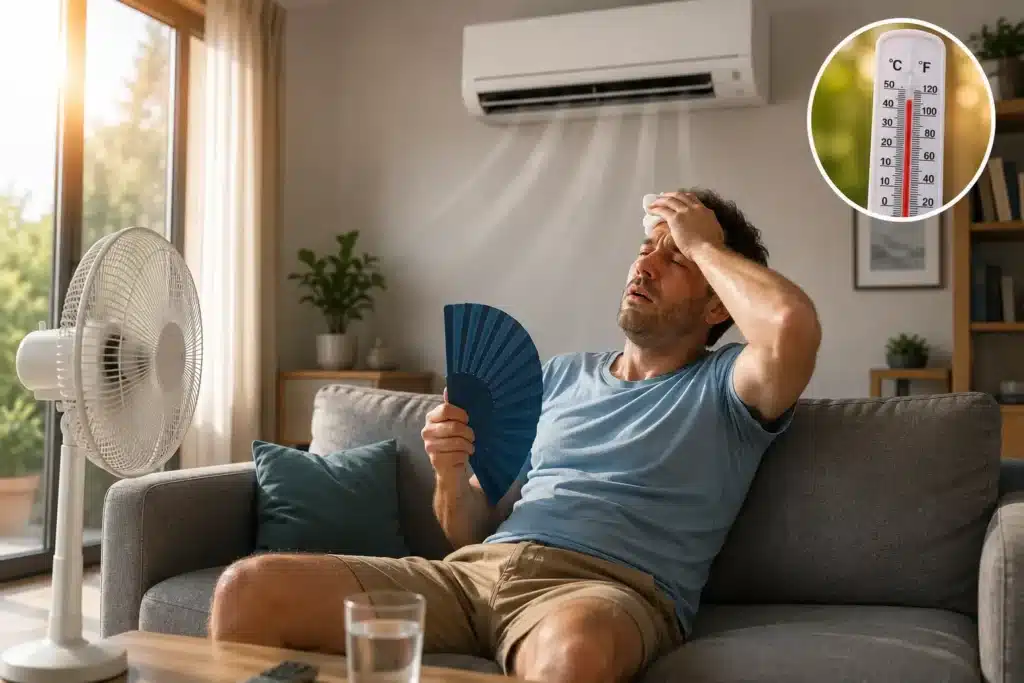
If AC is not blowing cold air, the problem usually involves heat transfer.
The most likely causes include refrigerant leaks, dirty coils, compressor issues, or airflow restrictions.
A properly functioning system should produce supply air that feels noticeably cooler than the room temperature.
Why Is My Upstairs Hot but Downstairs Cool?
This is another frequently searched question among homeowners.
Because heat naturally rises, upper floors often experience higher temperatures. Poor attic insulation, duct leakage, and airflow imbalances can make the problem worse.
If temperature differences between floors are significant, your HVAC contractor may recommend duct modifications or zoning solutions.
Should You Repair or Replace Your AC?
When an air conditioner stops cooling properly, many homeowners immediately wonder whether they should repair the system or replace it altogether. The answer depends on the age of the equipment, the cost of repairs, and the overall condition of the system.
In many cases, a repair is the most cost-effective solution. Issues such as dirty coils, failed capacitors, thermostat problems, or contactor replacements can often be fixed quickly and restore normal cooling performance.
A repair is usually the better option when:
- The system is less than 10 years old
- Repair costs are relatively low
- The AC has been well maintained
- This is the first major repair
- Energy bills have remained consistent
However, replacement may be worth considering if your system is nearing the end of its lifespan or experiencing frequent breakdowns.
You may want to consider replacing your AC if:
- The unit is more than 12 to 15 years old
- The compressor has failed
- Refrigerant leaks keep returning
- Repairs are becoming more frequent
- Energy bills continue to increase
- Your home never feels consistently comfortable
A common HVAC guideline is the $5,000 Rule. Multiply the age of the system by the repair cost. If the result exceeds $5,000, replacement is often the smarter long-term investment.
For example:
- 8-year-old AC × $400 repair = $3,200 → Repair
- 14-year-old AC × $500 repair = $7,000 → Consider Replacement
While this rule is not perfect, it provides a helpful starting point when evaluating your options.
At Air Time LLC, we help homeowners compare repair and replacement costs based on the condition of their system, energy efficiency goals, and long-term budget. Our goal is to recommend the solution that provides the best value, not simply the most expensive option.
Quick Repair vs. Replace Guide
| Situation | Repair | Replace |
| Dirty filter or coil | ✓ | |
| Failed capacitor or contactor | ✓ | |
| Thermostat problem | ✓ | |
| Refrigerant leak repair on a newer system | ✓ | |
| System over 15 years old | ✓ | |
| Compressor failure on the older unit | ✓ | |
| Frequent breakdowns | ✓ | |
| Rising energy bills and poor cooling | ✓ |
If your AC is not cooling the house and the system is more than a decade old, a professional evaluation can help determine whether investing in repairs still makes financial sense or if upgrading to a newer, more efficient system would provide better long-term value.
How Much Does It Cost to Fix an AC That Isn’t Cooling?
Repair costs vary depending on the root cause. The sooner a cooling issue is diagnosed, the lower the risk of additional damage.
| Repair | Typical Avg. Cost |
| Air Filter Replacement | $10-$40 |
| Thermostat Replacement | $100-$350 |
| Capacitor Replacement | $150-$400 |
| Contactor Replacement | $150-$450 |
| Coil Cleaning | $100-$500 |
| Refrigerant Leak Repair | $200-$1,500 |
| Fan Motor Replacement | $300-$900 |
| Compressor Replacement | $1,200-$3,500 |
When Should You Call an HVAC Professional?
Some problems require specialized tools and training.
You should contact an HVAC technician in San Antonio, TX, if you notice refrigerant leaks, recurring frozen coils, electrical failures, compressor issues, or persistent warm airflow.
Attempting complex repairs without proper experience can create safety risks and may void equipment warranties.
Frequently Asked Questions
Why is my AC running but not cooling the house?
The most common causes include dirty air filters, frozen evaporator coils, low refrigerant levels, dirty condenser coils, and compressor problems. Even though the system appears to be running, it may not be removing heat efficiently.
Why won’t my AC cool below 75 degrees?
This problem is often caused by extreme outdoor temperatures, restricted airflow, refrigerant issues, poor insulation, or an undersized air conditioning system. During Texas summers, systems frequently struggle to maintain temperatures below 75°F if underlying issues exist.
Is it normal for my AC to run all day in Texas?
Long cooling cycles are common during periods of extreme heat. However, if your AC runs continuously and never reaches the thermostat setting, the system may require maintenance or repair.
Why is my house still hot when the AC is on?
A house can remain hot despite the AC running because of poor insulation, air leaks, dirty coils, low refrigerant, blocked vents, or a malfunctioning compressor.
Why does my AC cool at night but not during the day?
During daylight hours, solar heat gain significantly increases cooling demand. If your system already has airflow restrictions, dirty coils, or refrigerant issues, those problems often become more noticeable in the afternoon.
Should I turn my AC off if it’s not cooling?
If you notice ice on the refrigerant lines, water around the indoor unit, burning odors, or unusual noises, turning the system off may prevent additional damage until a technician can inspect it.
Can a dirty air filter stop an AC from cooling?
Yes. A clogged filter restricts airflow and can reduce cooling performance significantly. In severe cases, it can cause the evaporator coil to freeze.
How long should it take an AC to cool a house?
Under normal conditions, lowering the temperature by one degree typically takes 30 to 60 minutes. Larger homes and extremely hot weather can increase cooling times.
Why is my upstairs hotter than downstairs?
Heat naturally rises, making upper floors warmer. Poor attic insulation, duct leakage, and airflow imbalances often make the problem worse.
Does extreme Texas heat affect AC performance?
Yes. When outdoor temperatures exceed 100°F, air conditioners must work much harder to remove heat from the home. Systems with maintenance issues often struggle to maintain comfort during these conditions.
Final Thoughts
If your AC is not cooling the house, start with these common basic AC issues. Check the thermostat settings, inspect the air filter, verify that vents are open, and make sure the outdoor unit is free from debris.
If these simple steps do not solve the problem, the issue may involve refrigerant levels, electrical components, or compressor performance. Addressing cooling problems early can prevent expensive breakdowns and help keep your home comfortable throughout the hottest months of the year.
Don’t let the summer peak pass without cooling. Our certified technicians diagnose your AC issues the same day — and give you straight answers on repair vs. replacement before we touch anything.