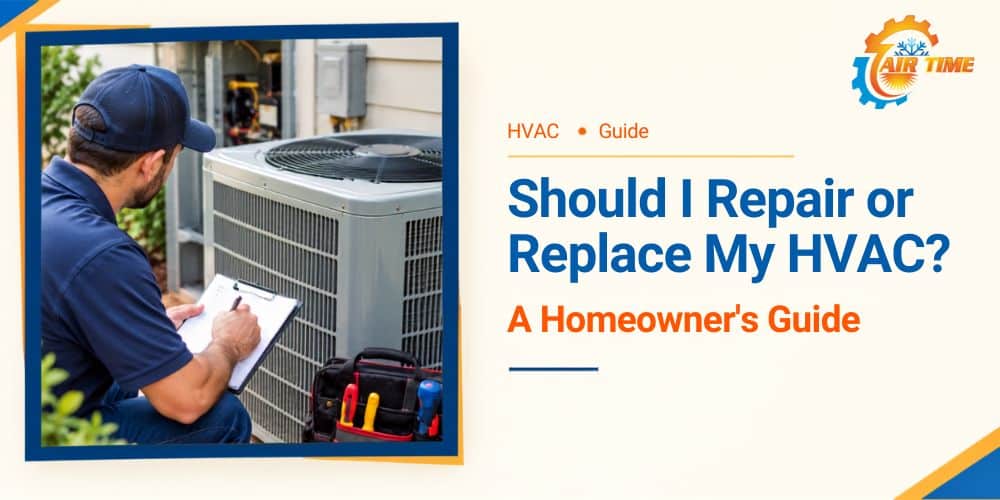
When your heating or cooling system starts acting up, one question quickly comes to mind: Should I repair or replace my HVAC? The answer is not always as simple as looking at the system’s age or the cost of one repair.
A newer HVAC system with a minor issue may be worth repairing, while an older system with frequent breakdowns, rising energy bills, and a major repair may be better replaced. The right decision depends on several factors, including the system’s age, repair history, efficiency, warranty, comfort, and overall condition.
For San Antonio homeowners, having a reliable HVAC system is especially important. Before spending money on another repair or investing in a new system, use the guide below to compare HVAC repair vs. replacement and determine which option may make more sense for your home.
Repair or Replace Your HVAC: What’s the Better Choice?
Repair your HVAC system when it is relatively new, has been reliable, needs a manageable repair, and still provides consistent heating or cooling.
Consider replacing your HVAC system when it is older, requires frequent repairs, has a major component failure, consumes more energy than expected, or can no longer maintain comfortable indoor temperatures.
| Factor | Repair May Make Sense | Replacement May Make Sense |
| System age | Relatively new | Older or nearing the end of its service life |
| Repair cost | Minor or manageable | Expensive compared with replacement |
| Repair history | Occasional repair | Frequent breakdowns |
| Energy bills | Relatively stable | Increasing without major usage changes |
| Comfort | Consistent temperatures | Hot and cold spots |
| Warranty | Active coverage | Expired coverage |
| Efficiency | Still performing well | Outdated or declining |
| Major components | Most components healthy | Major component failure |
| Long-term outlook | Several useful years remain | More repairs are likely |
There is no single formula that determines whether every HVAC system should be repaired or replaced. Your equipment’s condition, installation, maintenance history, and expected remaining service life all matter.
1. How Old Is Your HVAC System?
System age is one of the first things to consider when deciding whether to repair or replace HVAC equipment. However, age should be treated as a guideline rather than an automatic replacement deadline.
A properly maintained system may continue providing reliable service beyond its typical expected lifespan, while a poorly maintained or frequently repaired system may become expensive to keep much sooner.
As a general starting point:
- Under 5 years: Repair is often worth considering, particularly if warranty coverage applies.
- 5 to 10 years: Compare the repair cost with the system’s condition and repair history.
- 10 to 15 years: Carefully compare continued repair costs with HVAC replacement options.
- 15+ years: Replacement deserves serious consideration, especially when a major component fails.
Age Isn’t Everything
A 12-year-old HVAC system does not automatically need to be replaced.
For example, if your system has been professionally maintained, has needed very few repairs, and still provides reliable comfort, repairing a smaller issue may be a sensible choice.
On the other hand, a seven-year-old system that has experienced repeated breakdowns and now needs a major repair may deserve a replacement evaluation.
The better question is:
How much reliable service can I reasonably expect after making this repair?
2. How Much Does HVAC Repair Cost?
Your HVAC repair cost is another important part of the decision.
A relatively inexpensive repair on a well-maintained system is very different from a major repair on an aging system that has already required several service calls.
Before approving a repair, ask your HVAC technician:
- What exactly failed?
- Why did it fail?
- How much will the repair cost?
- Is the repair covered by a warranty?
- Are there other components showing signs of wear?
- How long could the repair reasonably extend the system’s useful life?
Repairs That May Be Worth Making
Depending on the system’s age and overall condition, homeowners may find it reasonable to repair problems involving:
- Capacitors
- Contactors
- Thermostats
- Certain electrical components
- Drainage issues
- Some blower components
- Minor airflow problems
Repairs That May Justify a Replacement Discussion
It may be worthwhile to compare HVAC replacement costs when your system has:
- Compressor failure
- Major coil damage
- Significant refrigerant leaks
- Heat exchanger problems
- Multiple failed components
- Repeated failures of the same component
The important question is not simply, “How much is the repair?”
Instead, ask:
“What will I have after paying for this repair, and how reliable is the system likely to be afterward?”
3. Look at Your HVAC Repair History
One of the biggest mistakes homeowners make is looking only at today’s repair bill.
Consider how much you have already spent keeping the system running.
For example:
| Recent Repair | Cost |
| First repair | $450 |
| Second repair | $700 |
| Third repair | $900 |
| Current repair | $1,800 |
| Total | $3,850 |
If the HVAC system is also 14 or 15 years old, another major repair may not provide the best long-term value.
However, if a six-year-old system has been reliable and suddenly needs a $600 repair, repairing it may make much more sense.
Also Read: Signs Your AC Needs Immediate Repair
Repair frequency can tell you more than a single repair bill.
If you have needed multiple significant repairs within the last year or two, ask an HVAC professional whether the latest problem appears to be isolated or part of a larger pattern.
4. Consider Energy Efficiency and Rising Utility Bills
Your HVAC system can become less efficient as it ages or develops mechanical problems. If your energy bills are increasing without a major change in your household’s usage, your heating and cooling equipment may be one factor worth investigating.
Newer HVAC equipment can offer improved efficiency and better temperature control. However, replacing the equipment does not automatically guarantee lower energy bills.
Your HVAC contractor should also consider:
- Ductwork condition
- Airflow
- Insulation
- Equipment sizing
- Thermostat operation
- Air leakage
- Maintenance condition
A poorly designed or leaking duct system can reduce comfort and waste energy even when the HVAC equipment itself is relatively new.
That’s why a professional evaluation should look at the complete heating and cooling system, not just the outdoor unit or furnace.
5. Is Your HVAC System Still Keeping Your Home Comfortable?
A system can still turn on and run while failing to provide the comfort your home needs.
Pay attention to signs such as:
- Hot and cold rooms
- Weak airflow from vents
- Excessive humidity
- Long or frequent cycles
- Increasing operating noise
- Difficulty maintaining the thermostat setting
- Rooms that never reach the desired temperature
These problems can indicate an aging or underperforming system, but they can also result from ductwork, insulation, airflow, or sizing problems.
Before replacing your equipment, make sure the actual cause of the comfort problem has been identified.
Also Read: AC Not Cooling House? 17 Causes, Fixes & Repair Costs
6. Check Your HVAC Warranty Before Paying for Repairs
Before approving an expensive HVAC repair, check whether your equipment is still covered by a manufacturer’s or extended warranty.
Depending on the equipment and warranty terms, certain components may have parts coverage even when labor is not covered.
Ask your HVAC professional to help verify:
- Equipment age
- Model and serial number
- Warranty status
- Failed component
- Parts coverage
- Labor coverage
- Additional repair costs
A repair that initially looks expensive may become more reasonable if an eligible component is covered.
7. What About Older Refrigerants?
Older HVAC systems may use refrigerants that are no longer commonly used in newer equipment. If an older air conditioner develops a refrigerant leak, simply adding refrigerant may not always be the best long-term solution.
The technician should evaluate the leak, the condition of the equipment, the repair cost, and the system’s age before recommending the next step.
If your older system has a significant refrigerant problem, ask:
“If I repair this refrigerant issue, what other problems or expenses should I expect from this system?”
That answer can help you compare a short-term repair with the long-term value of HVAC replacement.
8. Is the $5,000 HVAC Rule Reliable?
You may have heard of the $5,000 rule for HVAC repair.
The basic calculation is:
System age × repair cost = decision score
For example:
- 6-year-old system × $500 repair = $3,000
- 10-year-old system × $1,000 repair = $10,000
- 15-year-old system × $1,500 repair = $22,500
A higher result can indicate that replacement deserves closer consideration.
However, this is only a rule of thumb. It should not replace a professional assessment of your HVAC system.
The same repair can make financial sense on one system and be a poor investment on another because of differences in:
- Maintenance history
- Efficiency
- Warranty coverage
- Repair frequency
- Installation quality
- Remaining service life
- Replacement cost
Use formulas like this as a starting point, not a final answer.
9. Three Real-World HVAC Repair vs. Replacement Examples
Example 1: Six-Year-Old HVAC With a Minor Repair
Your HVAC system is six years old, has been maintained regularly, and needs a $500 component replaced.
Likely decision: Repair.
The system is relatively young, the repair is limited, and there is no history of repeated major failures.
Example 2: 16-Year-Old HVAC With a Major Repair
Your HVAC system is 16 years old, needs a $3,000 major repair, and has already required two repairs during the previous 18 months.
Likely decision: Consider replacement.
The combination of system age, repair cost, and repair history makes HVAC replacement worth investigating.
Example 3: 11-Year-Old HVAC With a Moderate Repair
Your system is 11 years old and needs a $1,200 repair. It has otherwise been reliable and properly maintained.
Likely decision: Compare both options.
This is a gray area. Repairing the system may still be the right choice, but getting a replacement estimate gives you a better understanding of your long-term options.
10. Don’t Forget About Your Ductwork and System Size
Sometimes homeowners replace an HVAC system because they believe the equipment is the problem, when the real issue is elsewhere.
Ductwork leaks, inadequate insulation, restricted airflow, or incorrect system sizing can all affect comfort and efficiency.
Before replacing an HVAC system, ask whether the technician has evaluated:
- Supply and return ductwork
- Airflow
- Insulation
- Return-air capacity
- Equipment sizing
- Thermostat operation
- Overall system performance
A new HVAC system needs to be properly matched to your home. Simply installing a larger unit does not necessarily mean better cooling.
11. When Is HVAC Replacement the Better Choice?
There is no universal age at which every HVAC system should be replaced. However, replacement becomes more attractive when several warning signs appear at the same time.
Consider getting an HVAC replacement estimate if your system:
- Is approaching the end of its expected service life
- Requires frequent repairs
- Has a major component failure
- Has declining efficiency
- Produces inconsistent temperatures
- Has serious safety concerns
- Requires an expensive repair
- Has ongoing refrigerant-related problems
- No longer reliably heats or cools your home
Getting a replacement estimate does not mean you have to replace the system. It simply gives you another option to compare against the cost of continued repairs.
HVAC Repair vs. Replacement Decision Checklist
Before making your decision, ask yourself these questions:
- How old is my HVAC system?
- What exactly failed?
- How much will the repair cost?
- How many repairs have I needed recently?
- Is the failed component covered by warranty?
- Are my energy bills increasing?
- Does the system still maintain comfortable temperatures?
- Does the system use an older refrigerant?
- How much would a comparable replacement cost?
- Could ductwork or airflow problems be contributing to the issue?
- How much useful life could I reasonably expect after the repair?
If most of your answers point toward a reliable system and manageable repair costs, HVAC repair may make sense.
If several answers point toward an aging system, repeated breakdowns, declining efficiency, and expensive repairs, HVAC replacement may provide better long-term value.
Final Verdict: Should You Repair or Replace Your HVAC?
The answer to “Should I repair or replace my HVAC?” depends on the complete picture, not one number.
A relatively new HVAC system with an isolated and affordable problem is often worth repairing. An older system with frequent breakdowns, increasing operating costs, poor comfort, and a major repair may be a better candidate for replacement.
Before making a decision, compare:
System age + repair cost + repair history + efficiency + warranty + comfort + safety + future repair risk.
If you’re unsure which option is right for your home, schedule a professional HVAC inspection. A qualified technician can identify the cause of the problem, evaluate the condition of the equipment, and explain whether repairing the existing system or replacing it makes more sense.
At Air Time LLC, our experienced HVAC professionals help San Antonio homeowners make informed heating and cooling decisions. We focus on diagnosing the actual problem and providing clear recommendations so you can choose the option that fits your home’s needs and your budget.
Frequently Asked Questions
Is it better to repair or replace an old HVAC system?
It depends on the system’s age, condition, repair history, efficiency, and repair cost. A minor repair may still be worthwhile on an older but reliable system, while a major repair on equipment with repeated failures may make replacement more practical.
Is it worth repairing a 10-year-old HVAC system?
It can be. A 10-year-old HVAC system with a good maintenance history and a reasonably priced repair may still have useful service life remaining. However, if major repairs are becoming frequent, compare the cost of continued repairs with HVAC replacement.
Should I replace my 15-year-old HVAC system?
A 15-year-old system is worth evaluating for replacement, particularly if it needs a major repair, has frequent breakdowns, or provides poor efficiency and comfort. However, age alone does not mean replacement is mandatory.
What is the $5,000 HVAC rule?
The $5,000 rule multiplies the system’s age by the estimated repair cost. A higher result is often used as a reason to investigate replacement. It is a general rule of thumb and should not be treated as a universal HVAC replacement formula.
How long does an HVAC system usually last?
HVAC lifespan varies depending on equipment type, installation quality, maintenance, usage, operating conditions, and other factors. Regular professional maintenance can help identify developing problems and support reliable operation.
Does a high HVAC repair bill mean I need a new system?
Not necessarily. Compare the repair cost with the equipment’s age, repair history, warranty coverage, efficiency, condition, and replacement cost before making a decision.
Will replacing my HVAC lower my energy bills?
A newer, properly sized and efficiently operating HVAC system may reduce energy consumption compared with an inefficient older system. However, ductwork, insulation, airflow, thermostat settings, and other home conditions also affect energy use.
Can a new HVAC system fix uneven temperatures?
It can, but uneven temperatures may also result from ductwork problems, insulation issues, restricted airflow, or improper system sizing. These issues should be evaluated before replacing the equipment.
Should I get an HVAC replacement estimate if I decide to repair?
Yes, especially if your system is older or the repair is expensive. Comparing a repair estimate with an HVAC replacement estimate can help you understand your short-term and long-term options.
How do I know whether my HVAC needs repair or replacement?
Start by evaluating the system’s age, repair cost, repair history, efficiency, comfort, warranty, and overall condition. When the decision is unclear, a professional HVAC inspection can help identify which option provides better long-term value.